If you know you should floss but the habit never sticks, try counting it off on one hand. Each finger stands for one step: your thumb for why you floss, your pointer for how much floss to use, your middle finger for how to wrap and guide it, your ring finger for checking what the floss tells you, and your pinky for the promise to do it every day. Five fingers, about two minutes, once a day.
This article walks through the five-finger method, what to do when flossing is hard on your hands, how to teach it to kids, and when something you notice while flossing is worth a visit to the Timonium office of Dr. Steven W. Haywood, DDS.
The five-finger flossing checklist
- Thumb: know why. Flossing cleans where your toothbrush can’t reach.
- Pointer: measure. Start with a generous length of floss.
- Middle finger: wrap and guide. Hug each tooth in a C shape.
- Ring finger: check. Notice bleeding, odor or snags.
- Pinky: promise. Tie flossing to something you already do every day.
Thumb: know why you floss
Plaque is a soft, sticky film of bacteria that builds up on teeth every day. A toothbrush cleans the front, back and chewing surfaces well, but where two teeth touch, the bristles mostly skim past. Those tight spaces, and the gumline just beside them, are where plaque is left behind most often.
Plaque left between teeth can lead to cavities that start on the sides of teeth, where they are hard to see in a mirror. It also irritates the gums. Over time, the bacteria can cause gum inflammation and infection, and periodontal disease is the leading cause of tooth loss in adults. Flossing isn’t mainly about removing food. It is about clearing away plaque before it causes trouble.
Pointer: measure out your floss
Break off about 18 inches of floss, roughly the distance from your fingertips to your elbow. That may seem like a lot, but you’ll use a clean section for each space between your teeth, and starting with enough keeps you from moving plaque from one tooth to the next.
If you use floss picks instead of string floss, rinse the pick whenever it looks dirty, or switch to a fresh one partway through. Compare the options in are floss picks as good as regular dental floss?
Middle finger: wrap and guide
- Wind most of the floss around one middle finger, and wind the rest around the middle finger of your other hand. That finger will take up the used floss as you go.
- Pinch the floss between your thumbs and index fingers, leaving a short, firm section between them.
- Guide the floss between two teeth with a gentle back-and-forth motion. Don’t snap it down onto your gums.
- When the floss reaches the gumline, curve it into a C shape against one tooth and slide it gently just under the gum.
- Move the floss up and down along the side of the tooth a few times.
- Curve it the other way and clean the side of the neighboring tooth.
- Unwind a fresh section from one middle finger, wind the used section onto the other, and move to the next space.
- Don’t forget the back side of your last molar on each side.
Ring finger: check what the floss tells you
Flossing is also a quick daily check-in on your mouth. Pay attention to a few signals.
Bleeding
Gums that bleed when you floss are usually inflamed. It is tempting to skip the spots that bleed, but leaving plaque there tends to make inflammation worse, so keep flossing gently. Bleeding that doesn’t settle down, or gums that are swollen, tender or receding, are signs worth having checked. Read the warning signs of gum disease.
Odor
If the floss smells unpleasant after you clean a particular space, plaque and food have been collecting there. It may just need more attention, but a spot that always smells can point to a gum pocket, a cavity or a filling edge that traps food. Read bad breath causes and treatment.
Snags and shredding
Floss that catches or shreds in the same place every time may be snagging on a rough filling edge, tartar or a cavity between the teeth. A space that always traps food is also worth pointing out. Mention it at your next visit so it can be looked at.
Pinky: make a promise and build the habit
The hardest part of flossing is remembering to do it. A few ways to make the habit stick:
- Attach it to brushing. Floss at the same time every day, such as right before you brush at night.
- Keep floss in sight. Put it next to your toothbrush, not in a drawer.
- Start small. If a full mouth feels like too much, floss your front teeth one day and add more each week.
- Give tender gums time. Gums that are not used to flossing may bleed or feel sore at first. Keep going gently.
- Keep a backup. Stash floss or floss picks in your bag, car or desk for days away from home.
When string floss is hard on your hands
Flossing with string can be frustrating if you have arthritis, limited reach, a strong gag reflex or large hands in a small mouth. Other tools can clean between teeth too:
- Floss holders and floss picks put the floss on a handle, so you need only one hand.
- Interdental brushes are small brushes that fit between teeth where there is space.
- Water flossers use a pulsing stream of water to flush plaque and food from between teeth and around dental work. Read why a water flosser might be a good idea.
Flossing around dental work
Bridges need special floss threaders or other aids to reach and clean all areas properly. Dental implants are cleaned much like natural teeth, but with extra attention, using tools such as interdental brushes and end-tuft brushes. If you have a temporary crown, pull the floss out the side instead of popping it up through the contact.
Teaching kids the five-finger method
Children can start having their teeth flossed once teeth touch each other. Young children usually need a parent to do it for them, and the five-finger checklist gives older kids a simple, playful routine to learn on their own. A pinky promise to floss before bed makes a good nightly ritual. For more on kids’ teeth, read how to prevent cavities in children.
How the practice helps between flossing sessions
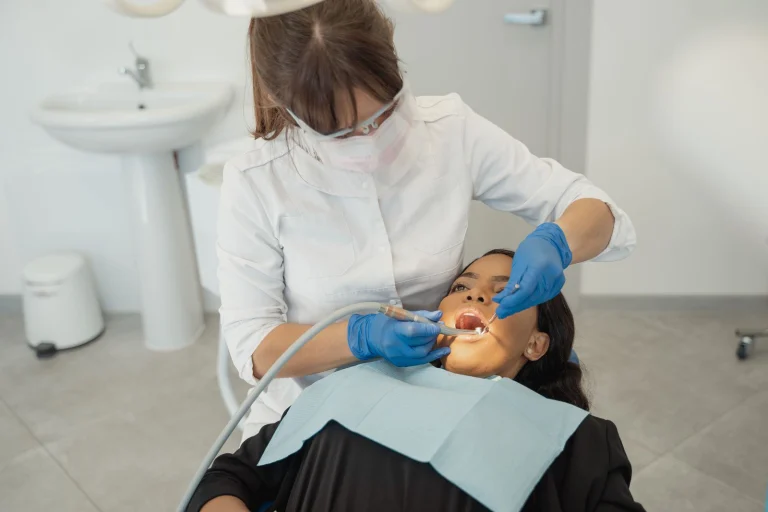
Flossing clears plaque, but once plaque hardens into tartar, only professional instruments can remove it. The practice recommends a professional cleaning every six months, and cleaning appointments here last a full 60 minutes. Your hygienist checks your gums with careful measurements, and if an infection is found, oral DNA testing can identify which bacteria are present. Ninety-eight percent of the practice’s periodontal therapy is non-surgical. See dental cleanings and preventive care and gum disease treatment.
Paying for your visit
The practice is out of network with all dental insurance providers. You pay at the time of your visit, and the office files the claim on your behalf so your plan can reimburse you for whatever it covers. Health savings and flex plans are welcome, and financing is available through CareCredit, with no-interest options for up to 12 months, and Cherry, with plans from 3 to 24 months. See financing options.
Frequently asked questions
Should I floss before or after brushing?
Either works. What matters most is cleaning between your teeth thoroughly once a day. Many people find it easiest to floss right before brushing at night, so it becomes part of one routine.
How much floss should I use?
About 18 inches, so you can use a fresh section for each space between your teeth.
Is it normal for my gums to bleed when I start flossing?
Some bleeding is common when gums are inflamed and not used to flossing. It often settles as you keep flossing gently. If it doesn’t, or your gums are swollen or receding, have them checked.
Is it too late to start flossing?
No. It is never too late to start cleaning between your teeth. If you haven’t flossed in a long time, a cleaning and exam first will show where your gums stand.
Get your gums checked in Timonium
If your floss keeps catching, smelling or turning pink, let the team take a closer look. Request an appointment or call (410) 453-9399. The office of Dr. Steven W. Haywood, DDS is at 108 W Timonium Rd, Ste 200, Timonium, MD 21093, and patients come from Timonium, Towson, Hunt Valley and Baltimore. Learn more about general dentistry in Timonium.
Ready to see your future smile?
Floss catching or bleeding in the same spot? Book a cleaning and gum check in Timonium.