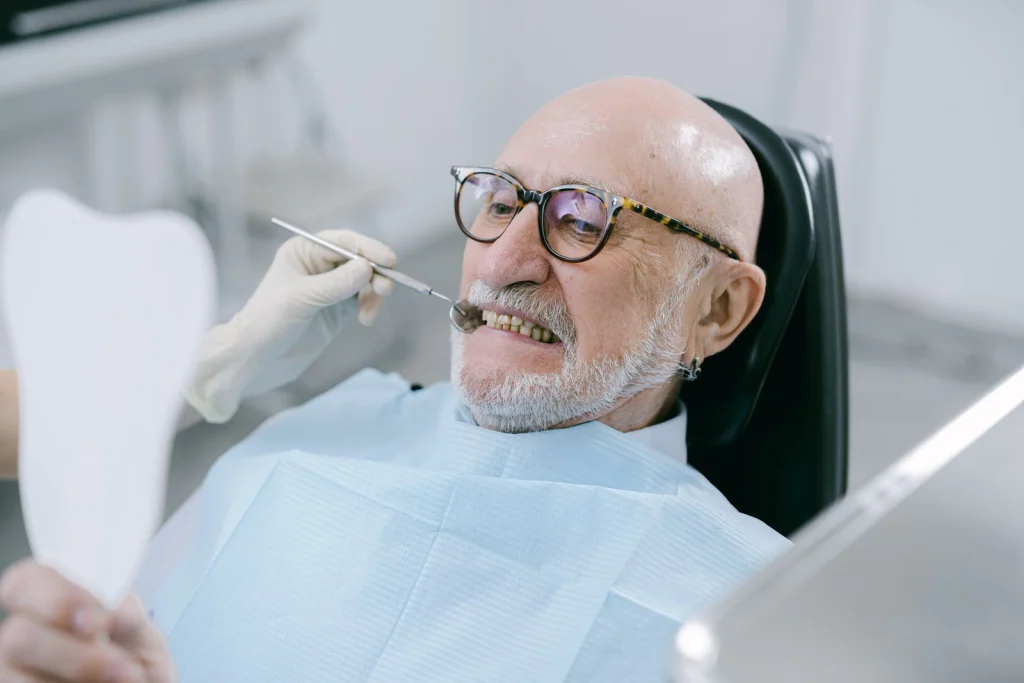
When all of your teeth slowly turn a little yellow, the cause is usually everyday staining and age. When one tooth turns darker than the rest, gray, brown or yellow while its neighbors stay the same, something is usually going on with that particular tooth. Tooth discoloration in a single tooth is worth having checked, because the cause can range from an old filling to a nerve that was injured years ago, and whitening alone rarely fixes it.
This guide explains the common reasons one tooth changes color, the signs that need prompt attention, how the Timonium office of Dr. Steven W. Haywood, DDS finds the cause, and the options for bringing that tooth back in line with the rest of your smile.
Why a single tooth changes color
An injury, even one from years ago
A knock to the mouth from a fall, a ball or a car accident can damage the nerve and blood supply inside a tooth. The tooth may look fine at first and slowly turn gray or darker over months or years. Many people cannot even remember the injury by the time the color changes.
A nerve that is infected or no longer healthy
Inside each tooth is a pulp chamber filled with connective tissue, with nerves running through the root canals. When infection reaches the pulp, or the nerve dies after an injury, the tooth can darken. Sometimes it hurts, and sometimes there is no pain at all.
Old metal fillings
Metal can discolor and age teeth, and a tooth with a large silver filling can take on a gray cast that shows through the enamel. Over time, fillings can also wear away, fracture or pull away at the edges, and a filling that is leaking can let decay develop underneath it.
Decay
Decay can show as a brown, gray or chalky area, particularly around the edges of old fillings or between teeth. Small amounts of decay are often invisible to the eye, which is why the practice uses tools that find it early.
A tooth that has had a root canal
A tooth that has had root canal treatment can darken over time. Every root canal at the practice is finished with a porcelain crown, which protects the fragile tooth and covers any change in color.
Surface stain on a bonded or rough tooth
Not every dark tooth is a problem inside. Composite bonding can stain, especially with cola, coffee, tea or red wine, so one bonded tooth may look darker than natural teeth nearby. A rough or worn surface can also pick up stain faster than smooth enamel.
When a discolored tooth needs prompt attention
Call the office soon if the dark tooth comes with any of these:
- pain that comes and goes when you chew, or a constant throbbing ache
- swelling in the gum or face near the tooth
- a pimple-like bump on the gum, or a bad taste that keeps returning
- a tooth that feels loose or looks longer than before
These can be signs of an abscess, which usually starts when a tooth’s nerve becomes infected. The bacteria can spread through the jaw and cause swelling that can become life threatening. Antibiotics can slow the spread, but the tooth still needs treatment. Call early in the day if you can; read more about oral infection signs.
How the cause is found
The color alone doesn’t tell the whole story, so the first step is a careful look:
- A thorough exam of the tooth, the gum around it and your bite.
- Digital X-rays, which appear on screen right away with less radiation than standard dental X-rays, so you can see what Dr. Haywood sees.
- An intraoral camera that zooms in on the tooth and shows issues that would otherwise be hidden.
- DIAGNOdent, a laser that can detect small amounts of decay at the earliest stages, sometimes before it shows on an X-ray.
- A cone beam CT scan when more detail is needed. It gives a full 3D view of the teeth and jaw and is used to assess existing root canals.
Why teeth whitening in Timonium may not fix one dark tooth
Professional whitening works on the color of your natural teeth, and it is excellent for stains from coffee, tea, red wine and smoking across a whole smile. It is less predictable for a single tooth that is dark from the inside, and it does not change the color of fillings, bonding, crowns or veneers at all. Whitening the rest of your teeth can even make one dark tooth stand out more.
That doesn’t mean whitening has no role. Whitening plans at the practice are customized, and if your teeth are very dark, Dr. Haywood counsels you on your options before you start. When a dark tooth is going to be restored, it often makes sense to whiten the other teeth first, so the new restoration can be matched to your brighter shade. For stains across all your teeth, see teeth whitening for stained teeth and whitening vs bleaching.
Treatment options for one discolored tooth
Treat any infection first
If the nerve is infected, root canal therapy removes the cause of the pain and saves the tooth, and the tooth is then capped with a porcelain crown to protect it from re-infection. If you are weighing saving the tooth against replacing it, read root canal vs dental implant.
Replace an old metal filling
The practice never uses amalgam. Old metal fillings can be removed under rigorous safety protocols and replaced with tooth-colored composite matched to your teeth, or with a bonded ceramic inlay or onlay when more of the tooth needs rebuilding. Learn about mercury-free dentistry.
Dental bonding
Dental bonding can repair discoloration with tooth-colored composite resin sculpted onto the tooth, usually in a single visit and typically with no anesthesia. It is one of the most affordable cosmetic procedures, though resin can stain over time.
A porcelain veneer
Porcelain veneers correct discolored and stained teeth, and porcelain resists stains better than natural teeth or composite. Over a very dark tooth, a veneer may need to be more opaque or thicker in that area so the color underneath doesn’t show through. You evaluate a trial set before the final veneers are made. See dental veneers.
A porcelain crown
When a filled front tooth has chipped or stained and a veneer isn’t a suitable solution, a crown may work well. Each dental crown is made to replicate the color and translucence of your natural teeth.
If the tooth can’t be saved
With modern dentistry, extractions are rare. If a tooth truly can’t be saved, a dental implant can replace it, and front tooth implants almost always use smaller implants and custom ceramic posts so the new tooth looks right.
Matching the tooth to your smile
A single tooth is one of the hardest things in dentistry to match, because the teeth beside it set the standard. Before-and-after imaging is part of every cosmetic evaluation, so you can preview the change on screen, and Dr. Haywood insists on a natural, never-fake look. If other teeth have also lost their brightness, a combined plan is often simpler; explore cosmetic dentistry in Timonium.
The practice is out of network with insurance companies: you pay at the time of service, and the office files the claim on your behalf so your plan can reimburse you for anything it covers. HSA and flex plans are welcome, and financing is available through CareCredit, with no-interest options for up to 12 months, and Cherry, with plans from 3 to 24 months.
Frequently asked questions
Does a gray tooth mean the tooth is dead?
Not always, but it can be a sign that the nerve was damaged. An exam and X-rays show what is happening inside the tooth and whether it needs treatment.
Can whitening fix one dark tooth?
Rarely on its own. Whitening works best on stains across all of your teeth and doesn’t change fillings, bonding or crowns. Bonding, a veneer or a crown usually gives a more reliable match.
Why did my tooth darken years after an injury?
Damage to the nerve and blood supply inside a tooth can take a long time to show. That is why a tooth that was knocked years ago can change color long after the bruise is forgotten.
Should I wait if it doesn’t hurt?
It is better not to. A discolored tooth can be infected without pain, and finding the cause early usually leaves more options open.
Have a discolored tooth checked in Timonium
If one tooth has lost its luster, find out why before you choose a fix. Request an appointment or call (410) 453-9399. The office of Dr. Steven W. Haywood, DDS is at 108 W Timonium Rd, Ste 200, Timonium, MD 21093, serving Timonium, Towson, Pikesville and Baltimore. If the dark tooth is one of several problems, read what can still be fixed in neglected teeth.
Ready to see your future smile?
One tooth darker than the rest? Have it checked in Timonium.