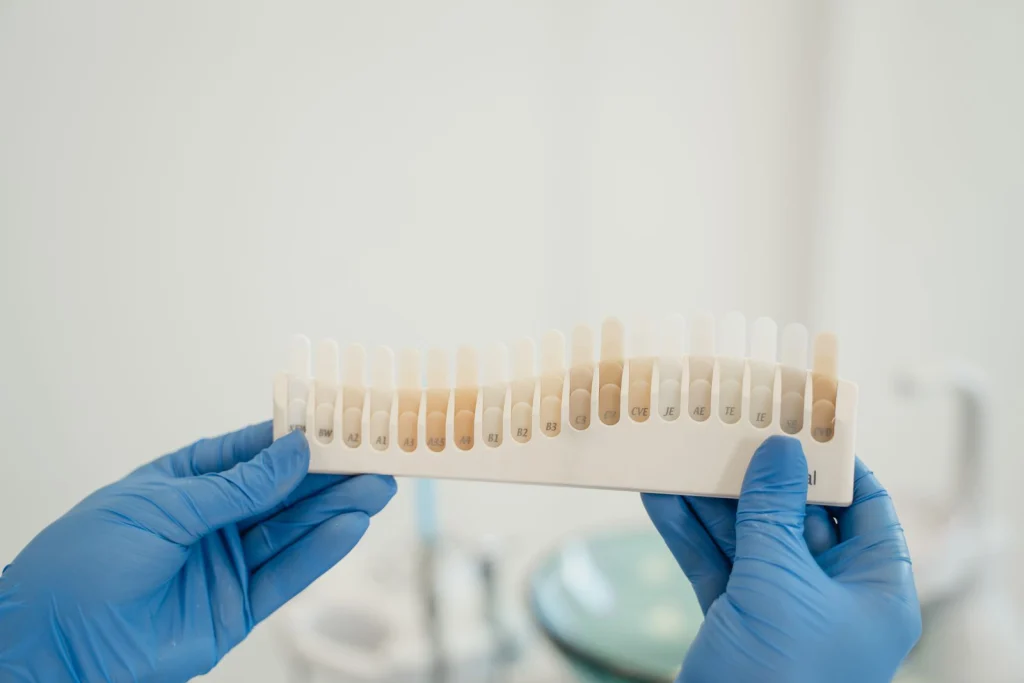
Teeth whitening lightens natural enamel only. Crowns, veneers, bonding and tooth-colored fillings keep the color they were made in, so if you have dental work on the teeth that show when you smile, whitening needs a plan. In most cases that means whitening your natural teeth first, then matching any new or replacement work to your brighter shade. At the Timonium office of Dr. Steven W. Haywood, DDS, whitening is done in the office as laser power whitening, and Dr. Haywood plans it together with any cosmetic or restorative work you have or want.
This guide explains how whitening affects each kind of dental work, the sensible order of treatment, what to do about gum recession and old metal fillings, and why do-it-yourself whitening is risky when you have restorations.
Teeth whitening in Timonium, MD, when you have dental work
Whitening agents work by breaking down stains in natural tooth enamel. Porcelain and composite resin don’t respond to them the same way. The result is simple to predict: your natural teeth get brighter, and your dental work stays exactly as it was. When that work is on a back tooth, nobody may ever notice. When it is on a front tooth, it can suddenly look darker than its neighbors.
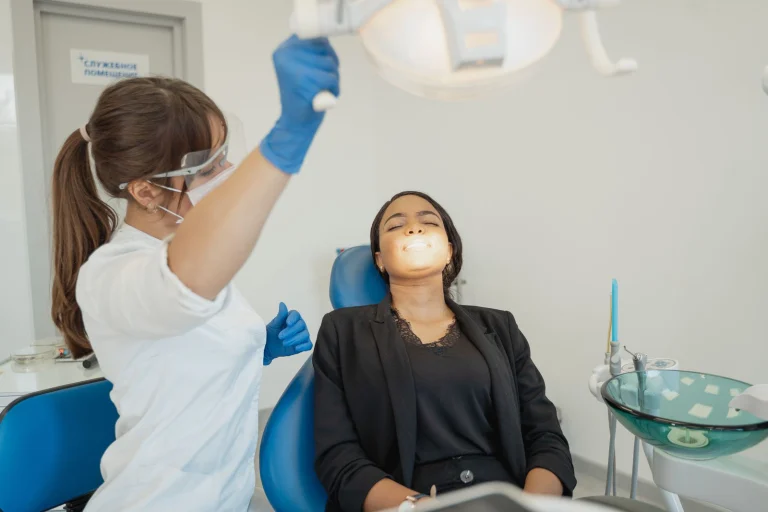
At the practice, a whitening consultation checks for fillings, crowns and veneers on your front teeth before anything begins, so the plan accounts for them. For the visit itself, read teeth whitening in Timonium: what to expect.
If you already have dental work
Porcelain crowns
A porcelain dental crown is made to replicate the color and translucence of your natural teeth as they were when it was made. After whitening, a front crown may no longer match. If it stands out, it can be replaced with a new crown matched to your brighter shade. Crowns are usually completed in two appointments: the tooth is prepared and a temporary is placed, then the permanent crown is checked for fit, bonded and polished.
Porcelain veneers
Veneers don’t lighten either, but porcelain resists stains better than natural teeth or composite, so well-cared-for veneers tend to hold their color. If you have veneers on some front teeth and natural teeth beside them, whitening can make the natural teeth brighter than the veneers. Talk that through before you whiten. See dental veneers.
Bonding and tooth-colored fillings
Composite resin keeps its original color and can also pick up stains over time. After whitening, visible bonding or fillings on front teeth may look darker and may need to be redone to match. Dental bonding can often be completed in a single visit, typically without anesthesia, which makes updating it relatively simple.
Old metal fillings
Silver fillings don’t whiten, and metal can discolor and age teeth. As a mercury-free practice, Dr. Haywood never uses amalgam, and old metal fillings can be replaced with tooth-colored composite matched to your teeth, following rigorous safe removal protocols. Read about mercury-free dentistry.
If you are planning new cosmetic work
If you are thinking about veneers, bonding or a crown on a front tooth, whitening first usually makes the most sense. Once your natural teeth are at the shade you want, new work can be made to match them, instead of matching your current, darker shade and locking it in.
There are also cases where whitening isn’t needed at all. Porcelain veneers correct discolored or stained teeth, and prepless veneers can brighten teeth without whitening for patients who qualify. If a tooth underneath is very dark, a veneer may need to be thicker or more opaque in those areas. See prepless veneers, or compare options in crown or veneer for a front tooth?
A sensible order of treatment
- Exam and health first. Cavities, gum problems and cracked teeth are treated before cosmetic work.
- A professional cleaning. Removing plaque and tartar gives whitening a clean surface to work on.
- Preview the plan. Cosmetic imaging shows a before-and-after of your smile on the imaging computer, so you can decide what to change. See cosmetic imaging.
- Whiten your natural teeth. A thirty-minute in-office whitening treatment is followed by a laser for 1 to 2 hours to activate the whitening agent.
- Match new or replacement work. Crowns, veneers and bonding are made to your new shade, when Dr. Haywood advises the time is right.
With veneers, you also evaluate a “test drive” set before the final set is made, so you see the color and shape in your own smile first. For a combined plan, read about ultimate smile makeovers.
Gum recession and exposed roots
When gums recede, part of the root shows. Root surfaces aren’t covered by enamel, and they may respond differently to whitening than the rest of the tooth. They can also be more sensitive. If recession is part of what bothers you about your smile, mention it at your consultation. Healthy gums come first, and a gum lift can change how gum tissue frames the teeth in some cases. Some sensitivity to cold air and fluids after whitening is common and fades within 24 to 36 hours; read tooth whitening sensitivity and your dentist.
Why DIY whitening is risky with dental work
Store whitening strips and gels can’t tell your natural teeth from your restorations. If you whiten at home with several crowns, veneers or bonded teeth in your smile, you may end up with teeth that no longer match each other, and unlike a bad hair color, it can’t simply be washed out. The commercial whiteners that seem so promising also often fail to deliver lasting results. An exam before whitening shows exactly which teeth will change and which won’t.
Keeping everything matched afterward
- Protect your new shade. For the first 24 hours after whitening, avoid red wine, dark colas, coffee, tea, red sauces, soy sauce and smoking.
- Care for composite. Brush or at least rinse well with water after cola, coffee, tea or red wine.
- Protect your investment. Bite protection is recommended for all cosmetic treatment, and veneers are warrantied for one full year.
- Whiten routinely. Keeping natural teeth at a steady shade helps them stay matched to dental work that doesn’t change.
For more, read how to keep a whiter smile after tooth whitening.
Why patients choose Dr. Haywood
Dr. Steven W. Haywood, DDS has more than 35 years of experience, cosmetic training from New York University’s Aesthetic Continuum and membership in the American Academy of Cosmetic Dentistry. Veneers are hand-crafted in the USA by master ceramists. Patients come to the Timonium office from Towson, Lutherville, Cockeysville, Hunt Valley, Pikesville and Baltimore, and the smile gallery shows before-and-after photos of actual patients.
Paying for whitening and cosmetic work
Every plan is different, so your fees are discussed at your consultation. The practice is out of network with all dental insurance providers: you pay at the time of your visit, and the office files the claim so your plan can reimburse you for whatever it covers. HSA and flex plans are welcome for eligible care, and financing is available through CareCredit, with no-interest options up to 12 months, and Cherry, with plans from 3 to 24 months. See financing options.
Frequently asked questions
Can you whiten teeth that have crowns?
You can whiten the natural teeth around a crown, but the crown itself won’t change color. If it is on a front tooth and no longer matches, it can be replaced with a crown matched to your new shade.
Should I whiten before getting veneers?
If you want your remaining natural teeth brighter too, whitening first usually makes sense, so the veneers can be matched to that shade. Veneers themselves correct discolored teeth, and prepless veneers can brighten without whitening.
Will whitening make my bonding look darker?
Bonding won’t get darker from whitening, but the natural teeth around it will get lighter, so the bonding can stand out. Visible bonding can be redone to match.
What if only one front tooth has a crown?
That is the most common situation where planning matters. Whitening first and then matching a new crown to the brighter shade usually gives the most even result.
Plan teeth whitening around your dental work in Timonium
Have crowns, veneers or bonding and want a brighter smile? Request an appointment or call (410) 453-9399 to schedule a consultation. The office is at 108 W Timonium Rd, Ste 200, Timonium, MD 21093. You can also read more about teeth whitening.
Ready to see your future smile?
Book a whitening consultation in Timonium and plan around your dental work.