Good decisions about your teeth start with understanding them. That is why patient education is a priority at the Timonium practice of Dr. Steven W. Haywood, DDS: before treatment, you should know what was found, what the options are and what the words on your treatment plan actually mean. Dental language can sound like a foreign vocabulary, though, so this guide gathers the terms you are most likely to hear at a checkup or consultation and explains each one in plain English.
How patient education happens at the practice
- A conversation first. Every visit starts with a conversation, not a drill, and appointments are scheduled so you are never rushed.
- Seeing it for yourself. Digital X-rays appear on a screen in the room, and intraoral cameras zoom in on each section of your mouth, so Dr. Haywood can point out problem areas and explain your options.
- Previewing results. Cosmetic imaging and the iTero Element scanner can show a simulation of what your results may look like before treatment.
- Clear priorities and costs. The team walks you through what needs doing, what can safely wait and exactly what it costs, before anything begins.
- Care instructions afterward. Written post-op instructions cover what to expect after each type of treatment.
For how those conversations turn into a plan, read how Dr. Steven Haywood, DDS plans your dental care. The glossary below is the companion to it.
Terms you may hear at a checkup
- Enamel, dentin and pulp: the three layers of a tooth. Enamel is the hard outer shell, dentin is the softer, yellower layer beneath it, and the pulp is the living center where the nerves and blood vessels run.
- Plaque: the soft, sticky film of bacteria that forms on teeth every day. Brushing and flossing remove it.
- Tartar (calculus): plaque that has hardened on the teeth. It can’t be brushed off and is removed at a professional cleaning.
- Cavity (caries): an area of tooth decay, where acids from plaque bacteria have broken down the tooth.
- Digital X-rays: X-ray images captured by a sensor and shown on screen immediately, with as much as 90 percent less exposure than film.
- Intraoral camera: a small camera that shows close-up images of your teeth on a screen.
- DIAGNOdent: a laser pen that detects small amounts of decay at the earliest stages, sometimes before it shows on an X-ray.
- Oral cancer screening: a quick, pain-free check of the soft tissues of the mouth, throat and tongue, recommended yearly for patients over eighteen. See oral cancer screening.
- ViziLite: a screening tool whose special solution turns abnormal cells blue under its light so they are easier to see.
- t-blue staining and Oral CDX: non-surgical techniques, available in the office, for a closer look at an area that needs more attention.
Gum health terms
- Gingivitis: early gum inflammation, often with red, puffy or bleeding gums.
- Periodontal disease (periodontitis): gum infection that has progressed below the gumline and can damage the bone that holds teeth. It is the leading cause of tooth loss in adults.
- Periodontal pockets: spaces that form between gums and teeth when gums are infected. Deep pockets mean infection.
- Recession: gums pulling back and exposing more of the tooth root.
- Scaling and root planing: a deep cleaning, also called root debridement therapy, that removes harmful bacteria from beneath the gums.
- Periodontal maintenance: ongoing cleanings that keep treated gum disease under control.
- Oral DNA testing: a test that identifies which periodontal bacteria are present so treatment can be more accurate.
More in gum disease treatment.
Terms for fillings and repairs
- Composite: tooth-colored resin used for fillings and bonding, mixed to match your teeth. The practice uses composite rather than metal.
- Amalgam: the silver-colored metal filling material that contains mercury. Dr. Haywood never uses amalgam, and old amalgam fillings can be removed under rigorous safety protocols.
- Bonding: composite resin applied and sculpted directly on a tooth to repair chips, fractures or discoloration, often in one visit.
- Inlay: a custom restoration bonded inside a tooth when only part of it is damaged.
- Onlay: like an inlay, but it also restores part of the biting cusp. Onlays keep more healthy tooth than a crown.
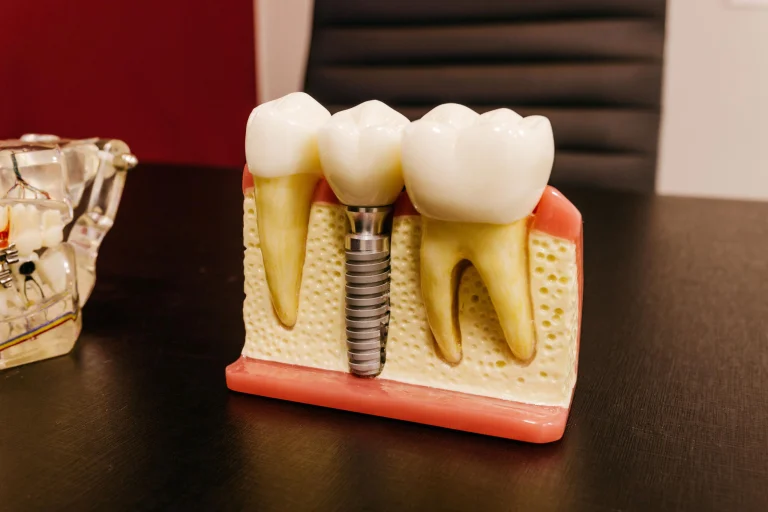
- Crown: a porcelain cap that covers a damaged tooth to restore its shape and protect it.
- Temporary: a short-term crown, bridge or filling that protects a tooth between appointments.
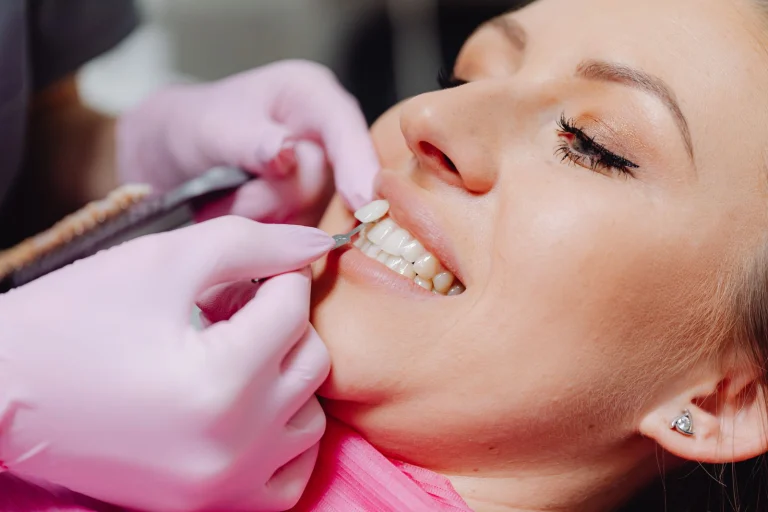
- Veneer: a thin, translucent shell bonded to the front of a tooth to improve its color, shape or position. Prepless or minimal-prep veneers need little or no drilling.
- Root canal therapy: treatment that removes infection from the pulp inside a tooth to save it. At the practice each root canal is finished with a porcelain crown.
- Abscess: a pocket of infection, often at the root of a tooth. It doesn’t always hurt, but it needs prompt treatment.
- Extraction: removing a tooth that can’t be saved.
Terms for replacing teeth
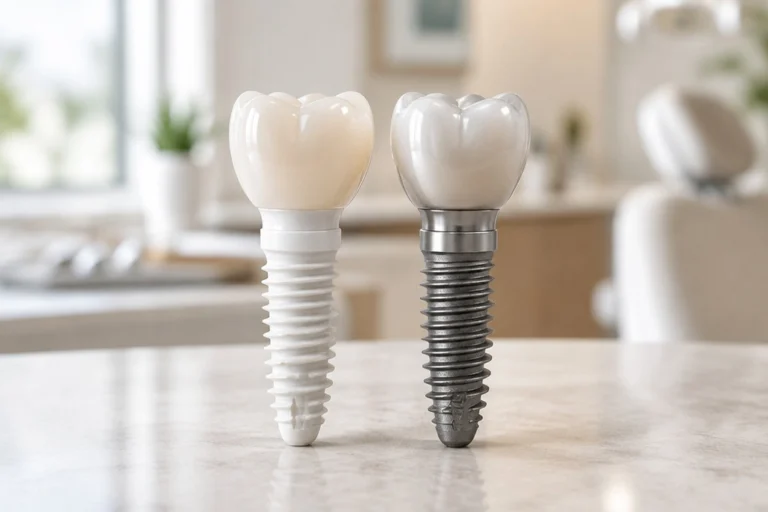
- Dental implant: a post placed in the jawbone to act as a new tooth root.
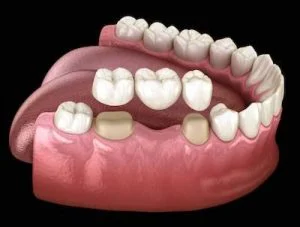
- Abutment: the connector that joins an implant to the tooth it supports. On a bridge, the abutment teeth are the natural teeth that hold it.
- Pontic: the artificial tooth in a bridge that fills the gap.
- Bridge: one or more artificial teeth held in place by crowns on neighboring teeth, or by implants.
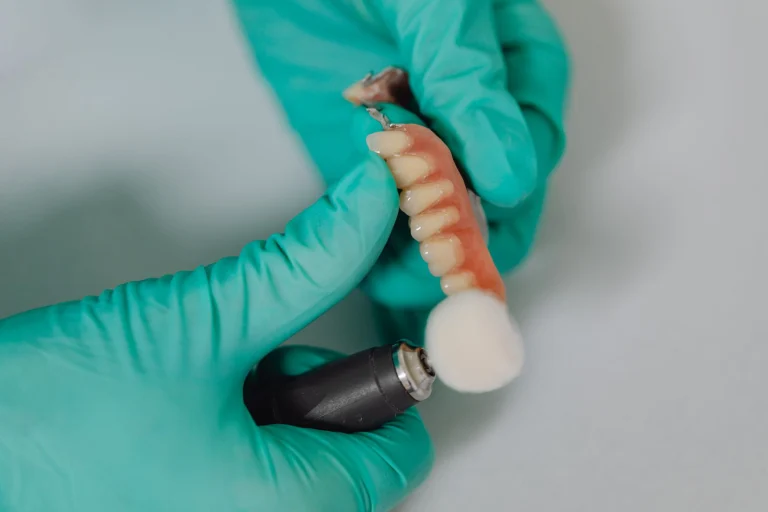
- Snap-on implant teeth: a removable denture that clicks onto implants for stability.
- All-on-4: a permanent, fixed set of teeth for a full arch, supported by dental implants.
- CBCT (cone beam CT): a 3D scan that shows the jawbone in detail. The practice uses a low-dose Green CT scanner.
- Bone graft: added bone material that builds up an area too thin to hold an implant.
- Surgical guide: a 3D-printed guide that helps place implants precisely.
See dental implants in Timonium.
Bite and jaw terms
- Occlusion: how your upper and lower teeth meet when you bite.
- Bruxism: grinding or clenching the teeth, often during sleep.
- TMJ and TMD: the temporomandibular joint is the jaw joint; TMD is a disorder of that joint, which can cause jaw tenderness, facial pain and headaches.
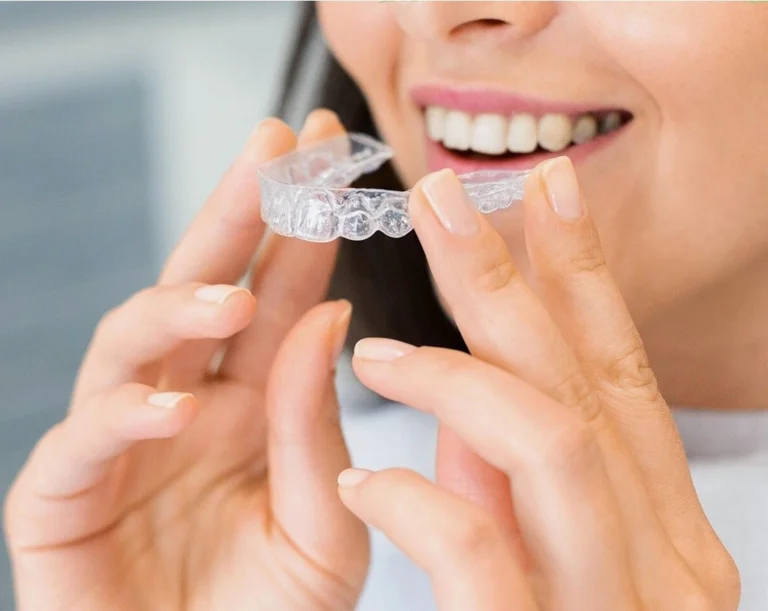
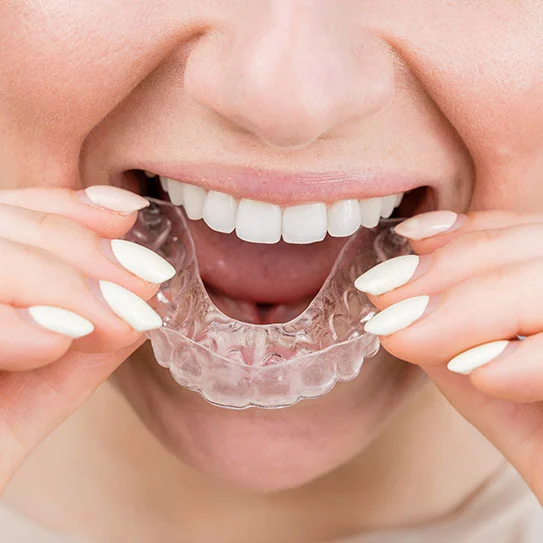
- Bite guard: a custom clear appliance that protects teeth from grinding.
- Occlusal splint: an appliance used to treat jaw joint problems; NTI splints are often used for acute TMJ pain.
Comfort and sedation terms
- Local anesthetic: numbing medicine for the area being treated.
- Laughing gas (nitrous oxide): a mild sedative breathed through a nasal mask. It is complimentary at the practice, and you can drive yourself home afterward.
- Oral conscious sedation: a pill taken about an hour before treatment to help you relax while staying conscious. You will need a ride.
- IV sedation: deep conscious sedation for lengthier or more complex treatment.
- Air abrasion: a stream of air and silica that removes small areas of decay with no heat, pressure or vibration.
Prevention and holistic dentistry terms
- Super sealants: coatings that seal the pits and grooves of chewing surfaces against decay, offered with a lifetime warranty.
- Calcium rebuilding treatment: a non-fluoride treatment to help strengthen enamel. The practice avoids fluoride.
- Xylitol: a natural sweetener in mints and lollipops that helps reduce decay risk.
- Biocompatible: describes a dental material chosen to suit your body. Restorations here are non-toxic, metal-free and biocompatible. See holistic dentistry.
Payment terms
- Out of network: the practice does not participate with any insurance company. You pay at the time of your visit, and the office files the claim on your behalf so your plan can reimburse you.
- HSA and flex plans: health savings and flexible spending accounts, which are welcome.
- CareCredit and Cherry: financing partners. CareCredit offers no-interest options for up to 12 months, and Cherry offers payment plans from 3 to 24 months. See financing options.
Questions worth asking about any treatment
- What exactly did you find, and can I see it?
- What happens if I wait?
- What are all of my options, including the most conservative one?
- How many visits will it take, and will I need a temporary?
- What will it cost, and how can I pay?
- How do I care for it afterward, and how long should it last?
Bring your list to your appointment, along with any X-rays from a previous dentist and pictures that help convey what you want for your smile.
Frequently asked questions
Can I see my own X-rays?
Yes. Digital X-rays appear on screen in the treatment room, so you can see what the team sees.
Will I know the cost before treatment starts?
Yes. The team explains what needs doing, what can safely wait and what it costs before anything begins.
Who can I ask about my treatment plan or insurance?
Kelley Fisher, the Patient Care and Treatment Coordinator, is the go-to for treatment plans, insurance questions and financing.
What if I don’t understand a term on my plan?
Ask. Nothing on your plan should be a mystery, and this glossary is a good place to start.
Learn about your smile with Dr. Steven Haywood
The more you understand about your teeth, the easier it is to keep them healthy. Request an appointment or call (410) 453-9399. The office of Dr. Steven W. Haywood, DDS is at 108 W Timonium Rd, Ste 200, Timonium, MD 21093. For more guides, visit the blog.
Ready to see your future smile?
Questions about your treatment plan? Talk it through with Dr. Haywood.