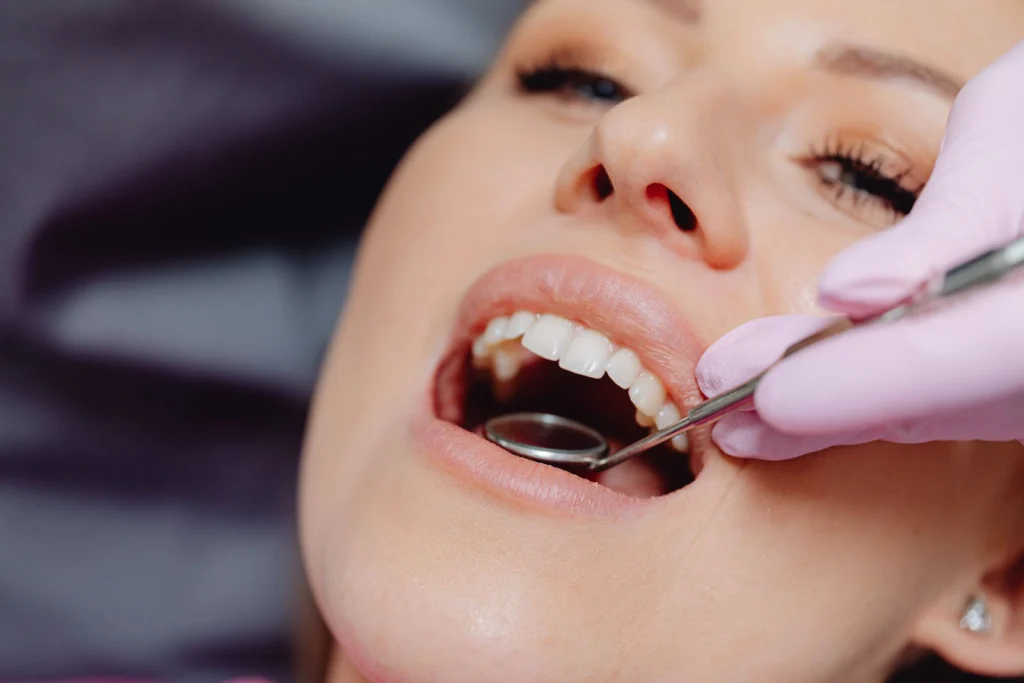
Bleeding gums after your 6-month cleaning are common, and a little bleeding or tenderness for a short time afterward is usually nothing to worry about, especially where your gums were already a bit inflamed. Bleeding that keeps going for more than a couple of days, or that comes with swelling, soreness, bad breath or gums pulling back from your teeth, is a different story. That is a sign to have your gums checked for gum disease.
If you are searching for help with bleeding gums in Timonium, MD, this guide explains why gums bleed after a dental cleaning, what is normal after a deep cleaning, when bleeding points to gum disease, what you can do at home, and how gum disease is treated at the Timonium office of Dr. Steven W. Haywood, DDS.
Why gums can bleed after a dental cleaning
A thorough cleaning removes plaque and hardened tartar from along the gumline and just below it. Healthy, firm gums usually handle that without much fuss. Gums that are inflamed, because plaque has been sitting along the gumline, are softer and bleed much more easily when they are touched. So the cleaning itself is often not the problem. It simply reveals inflammation that was already there.
After a regular cleaning
The practice recommends a professional cleaning every six months, and cleaning appointments here last a full 60 minutes. That time lets the hygienist remove plaque and tartar thoroughly, including in spots where daily brushing and flossing miss, and check on the health of your gums. If it has been a long time since your last cleaning, there is usually more buildup to remove and more inflammation, so some bleeding and tenderness afterward is more likely.
After a deep cleaning
If you need more than a regular cleaning, a deep cleaning called scaling and root planing may be recommended. According to the practice’s aftercare instructions, it is usually done in sections, with one half of the mouth cleaned in one session and the other half at a second visit. Your teeth and gums are numbed first, then cleaned with a combination of ultrasonic and hand instruments.
After a deep cleaning, it is normal to have some cold and hot sensitivity, and your teeth may even be sensitive to chewing. Your gums will be sore and may bleed. If an antibiotic such as Arestin is placed in a gum pocket deeper than 4 mm, the instructions are to postpone brushing for 12 hours, avoid flossing and other between-the-teeth cleaning devices for 10 days, and avoid hard, crunchy or sticky foods for a week. If anything feels wrong, call the office.
When bleeding gums are a sign of gum disease
Gum disease is an infection of the tissues that support your teeth. Signs can include:
- Gums that bleed when you brush or floss, or bleed after a cleaning and don’t settle
- Sore, red or swollen gums
- Bad breath that doesn’t go away
- Pus around the gumline
- Painful chewing or tooth sensitivity
- Teeth that look slightly longer because the gums have receded
- Deep pockets between the gums and teeth, found when your gums are measured
On their own these symptoms don’t necessarily mean you have gum disease, but they are a good reason to have your gums checked. Bleeding or receding gums, bad breath and deep pockets in the gums point to infection.
Gingivitis and periodontitis: why timing matters
Gum disease worsens as it progresses through its stages. In the early stage, usually called gingivitis, inflammation is limited to the gums. Left alone, the infection can move deeper into the tissues and bone that hold the teeth, which is called periodontitis. Periodontal disease is the leading cause of tooth loss in adults.
The encouraging part is that treatment can control and even reverse the early stages of gum disease. Gum infection that is caught early and treated as a serious infection can be managed and controlled. It is never completely cured, which is why ongoing care matters. The health of your gums has also been linked to serious health risks such as diabetes and cardiac disease, so caring for your gums helps protect your overall health, too.
Other reasons your gums might bleed
Gum disease is the most common reason gums bleed, but it is not the only one. It is worth mentioning any of these at your visit:
- Brushing too hard or using a hard-bristled toothbrush, which can irritate gums and contribute to gum recession
- Starting to floss again after a break, when inflamed gums bleed at first
- Medications, especially those that affect how your blood clots
- Hormonal changes, such as during pregnancy, which can make gums more prone to inflammation
- Nutrition, since a significant vitamin C deficiency is known to cause bleeding gums
- Other health conditions, which is why a complete health history is part of your first visit
What to do at home when your gums bleed
- Keep cleaning gently. It is tempting to avoid an area that bleeds, but leaving plaque there makes inflammation worse. Use a soft toothbrush and gentle strokes along the gumline.
- Clean between your teeth every day, unless you have been told to pause flossing after an antibiotic was placed. See floss picks vs. regular floss and why a water flosser might be a good idea.
- Follow your aftercare. After a deep cleaning, good home care includes regular brushing, flossing and a mouth rinse, either prescription or over the counter.
- Watch the pattern. If bleeding continues beyond a couple of days after a cleaning, keeps returning, or comes with swelling, pain or pus, call rather than waiting for your next visit.
How gum disease is treated at the Timonium office
Care for bleeding gums at Dr. Haywood’s practice is gentle and non-surgical: 98 percent of the practice’s periodontal therapy is non-surgical and comfortable. The practice’s experienced hygienists take the lead, identifying, explaining, treating and monitoring everything from small, isolated areas of gum disease to the most severe cases, and when you are diagnosed, Dr. Haywood meets with you to develop your individual treatment plan.
- Measure and test. The hygienists check your gums with careful measurements, and oral DNA testing can identify which of the 11 most suspected periodontal pathogens are present, so your condition can be treated more accurately.
- Remove the bacteria. Non-surgical scaling and root planing clears harmful bacteria from beneath the gums. Depending on your plan, treatment may add ultrasonic and anti-microbial irrigation, site-specific antibiotics such as Arestin or Atridox, and laser therapy.
- Keep your gums healthy. Periodontal maintenance and regular hygiene visits keep gum infection in check. The practice strives for zero bleeding and zero infection.
For patients who prefer a holistic approach, laser and ozone therapy clear bacteria and infection from the gums without chemicals, which tends to mean faster healing. Learn more about gum disease treatment in Timonium and holistic dentistry.
Why follow-up care matters
Treated gum disease needs ongoing attention. After a deep cleaning, your dentist or hygienist may put you on follow-up care every 3 to 4 months. Regular follow-up creates an environment for the gums and bone to heal and helps prevent further damage, and skipping it can let the gum condition return. If you have dental implants, cleanings every 3 to 4 months are recommended as well, because gums don’t seal around an implant as firmly as around a natural tooth.
Routine visits are part of general dentistry at the practice, alongside digital X-rays, oral cancer screening and tooth-colored fillings, all in the same Timonium office.
Paying for gum care
The practice is out of network with all dental insurance providers. You pay at the time of your visit, and the office files the claim on your behalf so your plan can reimburse you for whatever it covers. Health savings and flex plans are welcome, and financing is available through CareCredit, with no-interest options for up to 12 months, and Cherry, with plans from 3 to 24 months. See financing options.
Frequently asked questions
Is it normal for gums to bleed after a dental cleaning?
A little bleeding or tenderness for a short time is common, especially if your gums were inflamed. If bleeding continues beyond a couple of days or keeps coming back, have your gums checked.
Will my gums bleed after a deep cleaning?
They may. After scaling and root planing, the practice’s aftercare instructions say your gums will be sore and may bleed, and cold and hot sensitivity is normal. Call the office if you are concerned.
Which deficiency leads to gum bleeding?
A significant vitamin C deficiency is a known cause of bleeding gums, but plaque-related gum inflammation is far more common. An exam shows what is behind your bleeding, and your physician can check for nutritional or medical causes.
Should I stop flossing if my gums bleed?
Usually no. Gentle, daily cleaning helps reduce inflammation. The exception is after an antibiotic such as Arestin is placed in a gum pocket, when you should avoid flossing for 10 days as instructed.
Can gum disease be reversed?
Treatment can control and even reverse the early stages of gum disease. More advanced gum infection can be managed and controlled with treatment and ongoing periodontal maintenance.
Get bleeding gums checked in Timonium, MD
If your gums are still bleeding or sore after a cleaning, don’t wait for your next 6-month visit. Request an appointment or call (410) 453-9399. The office of Dr. Steven W. Haywood, DDS is at 108 W Timonium Rd, Ste 200, Timonium, MD 21093, serving Timonium, Towson, Pikesville, Baltimore and the surrounding communities. New patients are always welcome.
Ready to see your future smile?
Gums still bleeding after a cleaning? Book a gum check in Timonium.