Worn teeth tend to look shorter, flatter and older than they are, with uneven or chipped edges and sometimes a more yellow tone as the enamel thins. Porcelain veneers can restore the length, shape and edges those teeth have lost, using the look of healthy natural teeth as the guide. But veneers are only half the answer. If the reason your teeth wore down, such as grinding or a bite that doesn’t meet evenly, isn’t addressed first, the same forces go to work on your new porcelain. Depending on how much has been lost, bonding, crowns or orthodontics may also be part of the plan.
Here, Dr. Steven W. Haywood, DDS explains why teeth wear, what nature teaches about rebuilding them, and how worn teeth are restored at the Timonium office so the result looks like you, only better.
What worn teeth look like
Tooth wear usually happens so slowly that people don’t notice it until they see an old photo. Common signs include:
- Shorter front teeth. The biting edges wear down, so less tooth shows when you smile or talk.
- Flat, straight edges. The natural shape of the edges is lost, and teeth can look boxy.
- Chips and small cracks. Thinned edges are more likely to chip.
- Darker or more yellow teeth. As enamel thins, more of the darker layer underneath can show through.
- Sensitivity. Some people notice more sensitivity to cold as wear progresses. See sensitive teeth: causes and treatment.
Why teeth wear down
Grinding and clenching
Grinding and clenching put heavy, repeated force on the teeth, often during sleep, so many people have no idea they do it. Morning jaw soreness, headaches and chipped or flattened edges are common clues. Issues such as TMJ disorder or grinding can also hint at functional or bite problems worth evaluating.
A bite that doesn’t meet evenly
With proper alignment and a correct bite, pressure is distributed evenly when you bite down and each tooth functions as intended, reducing the potential for excessive wear and breakage as you age. When the bite is off, some teeth take more than their share of the load and wear faster.
Acidic foods and drinks
Frequent sipping of acidic drinks such as soda, sports drinks and citrus juices softens the surface of enamel, which makes it easier to wear away. For more, read soda spells double trouble.
Brushing too hard
Scrubbing with a hard brush can wear enamel and gums near the gum line over time. Gentle technique cleans just as well.
Using nature as the guide
The goal when restoring worn teeth isn’t a perfect row of identical white rectangles. It is to bring back what healthy, natural teeth look like, so the result fits your face and doesn’t look fake. Natural teeth give the design its rules:
- Proportion. Healthy front teeth are longer than they are wide, and the teeth beside them step down in size in a pleasing way.
- Edges. Natural biting edges are slightly translucent and gently shaped rather than ruler-straight.
- Color that varies. A natural tooth is not one flat shade; color and translucency shift from the gum line to the edge.
- Individuality. Neighboring teeth are similar but not identical, which is part of what makes a smile look real.
- The gum line. The shape and level of the gums frame each tooth.
Ultra-thin porcelain stays naturally translucent and shiny, like natural enamel, once it is bonded. Each veneer is customized for you, blending colors and translucencies with the small details that make a tooth look like a tooth. Dr. Haywood insists on a natural, never-fake look. For a broader look at smile design, read the artistry of cosmetic dentistry.
Bite first, then beauty
Restoring worn teeth without looking at the bite is like replacing worn tires without checking the alignment. That is why the bite is evaluated before cosmetic work is planned. Dr. Haywood completed advanced TMJ and reconstructive training at the Peter Dawson Institute, and planning how the teeth meet is part of every worn-teeth case.
One published patient review describes teeth that had never had decay but had broken off from a grinding habit. The bite was set in the right position first, and then a new set of teeth was created. That order, stabilize the bite and then rebuild, is what gives restored teeth the best chance of lasting.
Treatment options for worn teeth
Dental bonding for small chips and edges
When wear is limited to a chipped or slightly uneven edge, dental bonding can rebuild it with tooth-colored composite resin, usually in a single visit and typically without anesthesia. It is conservative and affordable, though resin stains and chips more easily than porcelain.
Prepless and minimal-prep veneers
Worn teeth are often good candidates for thin veneers, because the porcelain adds back length and thickness that the tooth has lost rather than making it bulky. Prepless veneers can strengthen chipped or worn teeth with little or no drilling, preserving most if not all of your enamel.
Traditional porcelain veneers
If worn teeth are also dark, heavily chipped or patched with older fillings, traditional porcelain veneers may give a stronger, more natural result. A veneer partially wraps the tooth like a suit of armor, protecting and strengthening it. See are you a candidate for traditional veneers?
Crowns for teeth with extensive damage
When wear has removed a lot of tooth structure, a crown covers and protects the whole tooth. Crowns can often save teeth that would otherwise need to come out. See dental crowns.
Orthodontics when position is part of the problem
If crowded or misaligned teeth are causing uneven wear, straightening can come first. Invisalign can move teeth into a better position before veneers, which can also make a more conservative veneer possible.
A full plan when many teeth are worn
When wear affects most of the mouth, a more complete plan may be needed. Sometimes a few teeth are enough; other times every tooth is treated for the best bite. Read full mouth reconstruction in Timonium.
See it and try it before it is final
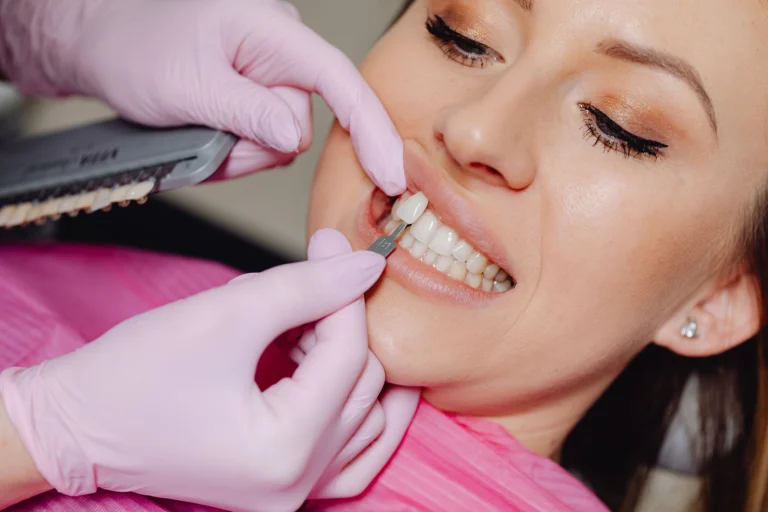
Adding length to worn teeth changes how your smile looks when you talk and laugh, so previewing it matters. A before-and-after demonstration on the cosmetic imaging computer shows possible changes before treatment begins. With porcelain veneers, you also receive a test-drive set to evaluate the shape, color and look before the final veneers are made. The final porcelain is hand-crafted in the USA by master ceramists.
Protecting restored teeth
The forces that wore down your natural teeth will still be there after treatment, so protection is part of the plan:
- Bite protection is recommended for any cosmetic treatment, and it matters most for people who grind.
- Never use your teeth to open packages or cut things.
- Keep up with brushing, flossing and professional cleanings.
- Limit acidic and staining drinks, and whiten your natural teeth routinely so they stay matched.
With appropriate care, porcelain veneers can last for decades. For a full routine, read how to care for porcelain veneers.
Cost, insurance and financing
Every case is unique, so fees are set after an assessment and depend on how many teeth are involved and which treatments your plan uses. Payment options, financing and pre-payment discounts are available, and staging treatment can help if you use a flex spending account.
The practice is out of network with all dental insurance providers: you pay at the time of your visit, and the office files the claim so your plan can reimburse you for whatever it covers. HSA and flex plans are welcome, and financing is available through CareCredit, with no-interest options up to 12 months, and Cherry, with plans from 3 to 24 months. See financing options.
Frequently asked questions
Can veneers fix short, worn front teeth?
Often, yes. Veneers can restore length and a natural edge to worn front teeth, and thin veneers can do it with little or no drilling when the teeth are otherwise healthy. The bite is evaluated first.
Will veneers make my teeth look too long?
They shouldn’t. The new length is planned around natural proportions, your face and your bite, and you see it on the imaging computer and in a test-drive set before anything is final.
Do I have to stop grinding before I get veneers?
Grinding doesn’t automatically rule veneers out, but it has to be part of the plan. Your bite is evaluated, and bite protection is recommended to protect the work.
Are crowns better than veneers for worn teeth?
It depends on how much tooth is left. Veneers suit teeth with wear mostly on the front and edges; crowns suit teeth that have lost a lot of structure.
Restore worn teeth in Timonium
If your teeth look shorter or more worn than they used to, an evaluation will show why it is happening and how to rebuild a natural-looking smile. Request an appointment or call (410) 453-9399. Dr. Haywood’s office is at 108 W Timonium Rd, Ste 200, Timonium, MD 21093. Learn more about dental veneers.
Ready to see your future smile?
Book an evaluation in Timonium to find out why your teeth are wearing and how to restore them.