Most myths about cosmetic dentistry aren’t about whether it is worth doing. They are about which treatment you need. A mistaken belief can steer you toward more treatment than your smile requires, or talk you out of an option that would have suited you better. Here are the common myths about cosmetic dentistry treatments that come up at consultations, and what is actually true about each one.
These answers come from the way cosmetic care is planned at the Timonium office of Dr. Steven W. Haywood, DDS, an AACD member trained at NYU’s Aesthetic Continuum and the Peter Dawson Institute. If you are more curious about myths around how a new smile looks, read celebrity smiles: myths vs. reality; for whitening myths, see tooth bleaching fact and fiction.
Why treatment myths matter
There is more than one way to fix a smile. Whitening brightens, bonding repairs, veneers reshape, a gum lift rebalances and orthodontics moves teeth. Several of these can solve the same problem in different ways, with different amounts of tooth preparation, time and upkeep. When a myth narrows your options before you have had an exam, you lose the chance to choose the approach that fits your teeth, your goals and your budget.
Myth 1: A bridge is the only way to replace a missing tooth
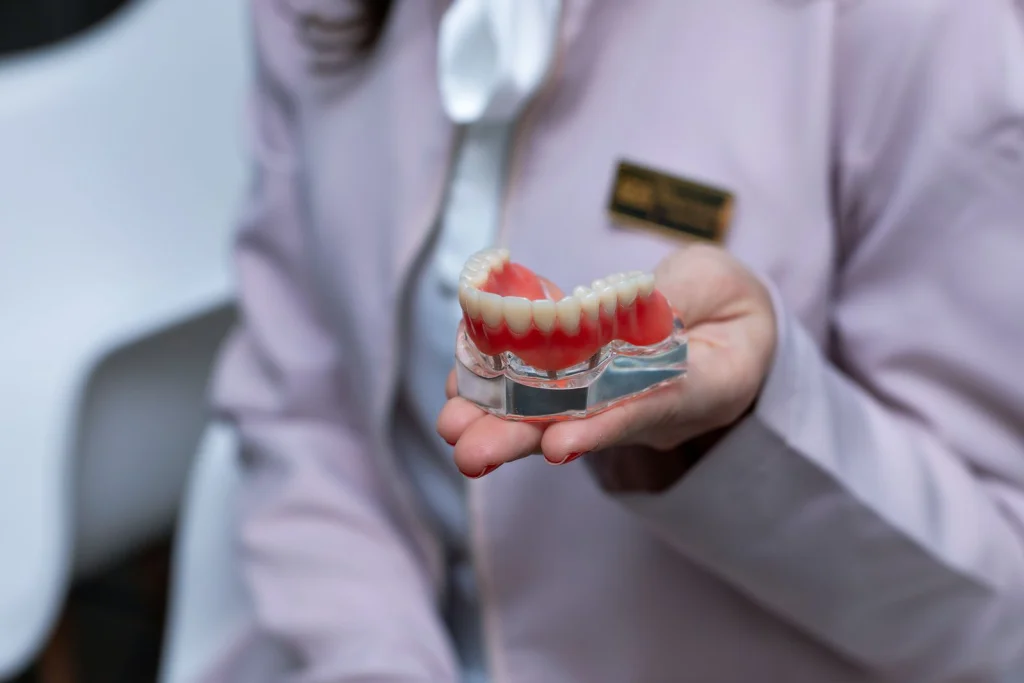
A dental bridge is a proven option: crowns fit over the teeth on each side of the gap to hold a replacement tooth in place. It is not the only choice, though. A dental implant replaces the root as well as the visible tooth, leaves the neighboring teeth untouched and helps prevent the bone loss that follows a missing tooth. In most cases implants are the better alternative, and implants can also anchor dentures so they don’t slip or click.
Which option suits you depends on the health of the neighboring teeth, your gums and bone, and your goals. Learn more about replacement options for missing teeth.
Myth 2: Braces are the only way to fix crooked teeth
Metal braces still have a place. They are the most economical orthodontic option and suit complex work on the bite, crowding and gaps. But there are several other paths:
- Invisalign clear aligners move teeth with a series of clear, removable trays. Dr. Haywood is an Elite Invisalign Provider.
- Invisalign Express is a thrifty way to achieve minor tooth movements.
- Instant orthodontics uses porcelain veneers, bonding, crowns and tooth and gum reshaping to make crooked, gapped or discolored teeth look straighter in as little as one or two visits.
The right choice depends on whether teeth need to physically move to correct the bite, or only need to look straighter. When teeth are too far out of position for veneers alone, Invisalign can shift them first. See orthodontic options for adults.
Myth 3: Bonding and veneers are the same thing
They can fix similar problems, but they are made differently. Dental bonding is tooth-colored composite resin sculpted directly onto the tooth, usually in a single visit and typically with no anesthesia. It is one of the most affordable cosmetic procedures. Composite can stain, though, and it is not as strong as enamel.
Porcelain veneers are thin shells hand-crafted in the USA by master ceramists and bonded to the front of the teeth. Porcelain resists stains better than natural teeth or composite and doesn’t break as easily. Bonding is also often a first step in a larger makeover. Compare the three types of veneer materials.
Myth 4: A chipped front tooth always needs a crown
Crowns are for teeth that have been extensively damaged. A small chip is often repaired with bonding in one visit. As one patient put it: “Dr. Haywood repaired a chip in my tooth today. The tooth looks better than before it was chipped!”
When a filled front tooth has chipped or stained and a veneer isn’t a suitable solution, a crown may work well. The practice’s approach is conservative: if a filling, bonding or an onlay will do the job, that comes first. Read crown or veneer for a front tooth.
Myth 5: Whitening can fix any kind of discoloration
In-office laser whitening activates the hydrogen peroxide in the whitening agent so stains dissolve, and each plan is customized. But whitening has limits. It does not change the color of existing crowns, veneers or tooth-colored fillings, and a single tooth that has darkened from the inside may not respond like its neighbors.
If your teeth are very dark, Dr. Haywood explains your options before you start. Veneers and bonding can correct discolored teeth that whitening can’t. Learn about discoloration in a single tooth.
Myth 6: A gummy smile means your teeth are too short
Often the teeth are a normal size and extra gum tissue covers them. Your smile line is shaped by your facial muscles, your lips, your teeth and your gum tissue. A gum lift moves the gum line upward on the upper teeth with a dental laser or radiosurgery for ideal tooth proportions. For bigger changes, the Haywood surgical smile makeover combines gum surgery with same-day custom veneers that help guide tissue healing. See gum contouring in cosmetic dentistry.
Myth 7: Veneers alone can fix any smile
Thin veneers cannot solve every problem. Where the tooth underneath is very dark or damaged, a veneer may need to be thicker or more opaque. Teeth with damage or older dental work often need traditional porcelain veneers rather than prepless ones. Teeth that sit far out of line may need to move first, which is why Invisalign is often combined with veneer makeovers. And gums need to be healthy before any cosmetic work begins, because veneers placed over infected gums would not last.
Myth 8: Cosmetic treatment means giving up conservative, mercury-free care
Looking good and treating teeth gently are not opposites. Dr. Haywood always chooses the thinnest veneer and the most conservative approach, and prepless veneers preserve most if not all of your natural enamel when you qualify. The practice never uses amalgam and restores teeth with tooth-colored, non-toxic and biocompatible materials. Learn about holistic dentistry at the practice.
Myth 9: You have to choose a treatment before you see the result
A before-and-after demonstration is part of every cosmetic evaluation. Digital photos of your smile are changed on the imaging computer, so you can compare approaches and plan the improvements together. With veneers, you also evaluate a “test drive” set before the final set is made. Treatment starts only when you approve the plan.
How the right treatment is chosen
- An exam and a conversation. Your visit starts with a thorough oral exam and a talk about what you would like to change. Jot down your goals beforehand so nothing gets missed.
- A look at health first. Gum health, decay, old dental work and your bite are checked, because cosmetic work has to be built on a healthy foundation.
- A preview. Cosmetic imaging shows how different options could look on your own smile.
- A plan you approve. It may be a single procedure or a combination. Each step is explained and your questions answered.
Explore all cosmetic dentistry in Timonium, or see how several treatments come together in an ultimate smile makeover.
Cost, insurance and financing
Every case is unique, so your fee is set after an assessment, and a clear estimate is given up front. The practice is out of network with insurance companies: you pay at the time of your visit, and the office files the claim so your plan can reimburse you for anything it covers. HSA and flex plans are welcome. Financing is available through CareCredit, with no-interest options for up to 12 months, and Cherry, with plans from 3 to 24 months.
Frequently asked questions
Is bonding or a veneer better for a chipped tooth?
For a small chip, bonding is often a quick, affordable fix done in one visit. Porcelain veneers resist stains better and don’t break as easily, so they may suit larger repairs or several teeth. Your exam and preview help you decide.
Can veneers straighten crooked teeth without braces?
Often, veneers can make crooked teeth look straighter. When teeth need to move before they are treated, Invisalign clear aligners can shift them into position first.
Is a dental implant a cosmetic treatment?
It is both. An implant restores chewing and helps prevent bone loss, and it also fills a visible gap, so implants are often part of a cosmetic plan.
Will whitening lighten my crowns or veneers?
No. Whitening changes natural tooth color only. When a plan includes whitening and new tooth-colored work, teeth are usually whitened first and the new work is matched to the brighter shade.
Get the facts about your own smile in Timonium
The best way past the myths is an exam and a preview of your options. Request an appointment or call (410) 453-9399. The office of Dr. Steven W. Haywood, DDS is at 108 W Timonium Rd, Ste 200, Timonium, MD 21093, serving Timonium, Towson, Hunt Valley, Pikesville and Baltimore.
Ready to see your future smile?
Find out which cosmetic treatment actually fits your smile.